
Stellar Scripting System So You Can Seriously Scale
Say that three times fast, then read so you can build your own multi-million dollar ads
What’s up!
Happy Thursday, if you celebrate. Here’s a gift anyway.
A promise we’re making to you in this newsletter is to screw up so you don’t have to. This week’s tool emerged from a whole bunch of screwups. We’re explaining the framework we use to script our multi-million-dollar ads.
What we look to do with our systems is get them foundationally strong enough so we’re not plagued by analysis paralysis every time we look to create something, and can simply let the creative juices flow. We sat down with Teddy to talk through creating ad campaigns, and he was the first to tell us that he’s had plenty of campaigns where there was a dam blocking those juices because he lacked a framework.
What you’re seeing below is the amalgamation of years of ad scripting and campaign building, organized for you into one simple visual tool and GPT model. So if you’re looking to launch your brand soon, looking to upgrade your ad scripting process, or just a curious reader, enjoy! (And if you’re a visual learner, we broke it all down here)

The seasonal campaign: your everything
Everything we’ll be discussing lives here.
Up top, you’ll see the seasonal campaign. When launching a new campaign, our goal is to create something that runs for years, instead of a gimmick that runs for one season (because building a brand takes time and patience).
So we build our campaign around either the brand’s core mission or the specific campaign’s tagline, which aligns with that mission. This is your stake in the ground. What separates you from the crowd.
This matters because it’s your North Star. It’s your guiding factor for everything below.

Breaking down by collections: audience + lifestyle
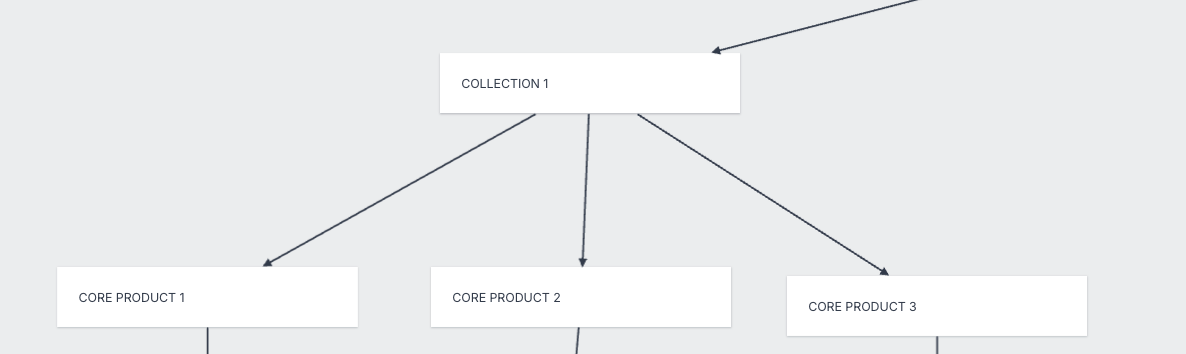
Now we break down by collections. A collection has at least 3 core products, and they’re organized by both audience and lifestyle/use case.
The cool part is that the same product resonate differently depending on who’s buying it and how they use it.
Take a water bottle for example.
A water bottle used by someone who mountain bikes speaks to durability, insulation, portability on the trail. A water bottle for someone road running speaks to lightweight design, hydration efficiency, what pros use. A water bottle for someone hitting the gym speaks to style, fitting in a gym bag, looking good while you train.
Same product, yet 3 completely different conversations. And multiply that by 3 different core products? Hey now.
The opportunities are endless. Think of all the ways your product can be communicated to different people. This framework lets you explore all of those scenarios. We work with lifestyle brands specifically because we love selling products that speak to a specific identity, use case, and audience. A lifestyle, if you would.
The product funnel: 4 ways to tell a story
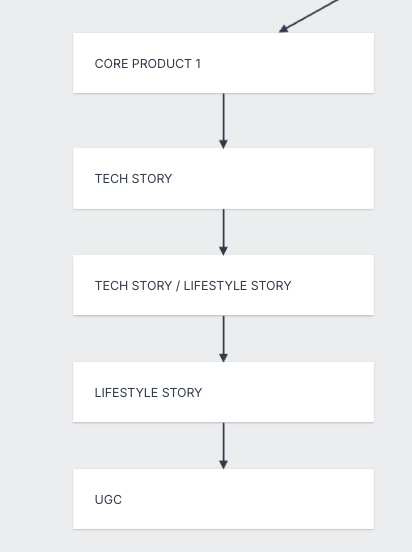
Through lots of trials and lots of errors, we broke down how customers of lifestyle brands buy, into five distinct categories. These are what we center the scripting for each product around.
Tier 1: The Tech Story
High-level technical features. The “what makes this built different” angle.
Example: Stone-ground. Non-GMO verified. Manufactured with intention.
Tier 2: The Tech Lifestyle Story
Why those technical features matter in real life. How the specs translate to experience.
Example: You taste the difference when something’s made with intention. One bowl and you know why chefs choose this.
Tier 3: The Lifestyle Story
Pure aspiration. Who can the customer become? What can they do with this?
No specs. Just the feeling and identity. The version of themselves they’re buying into.
Tier 4: UGC (User-Generated Content) / MGC (Marketer-Generated Content)
UGC: Real customers using the product. Customer footage plus voiceover from their perspective.
This is authenticity. It’s someone like them, doing the thing, and loving it.
MGC: Your team or models using the product. On-site footage plus voiceover from the model’s perspective.
Why MGC exists: You can control the narrative when UGC isn’t available yet. You’re speaking from a position of expertise, showing how the product fits into the lifestyle you’re building.
The GPT tool: where the magic happens
This is where we get futuristic on you (or maybe for some we’re still stuck in the past, but we’ll catch up).
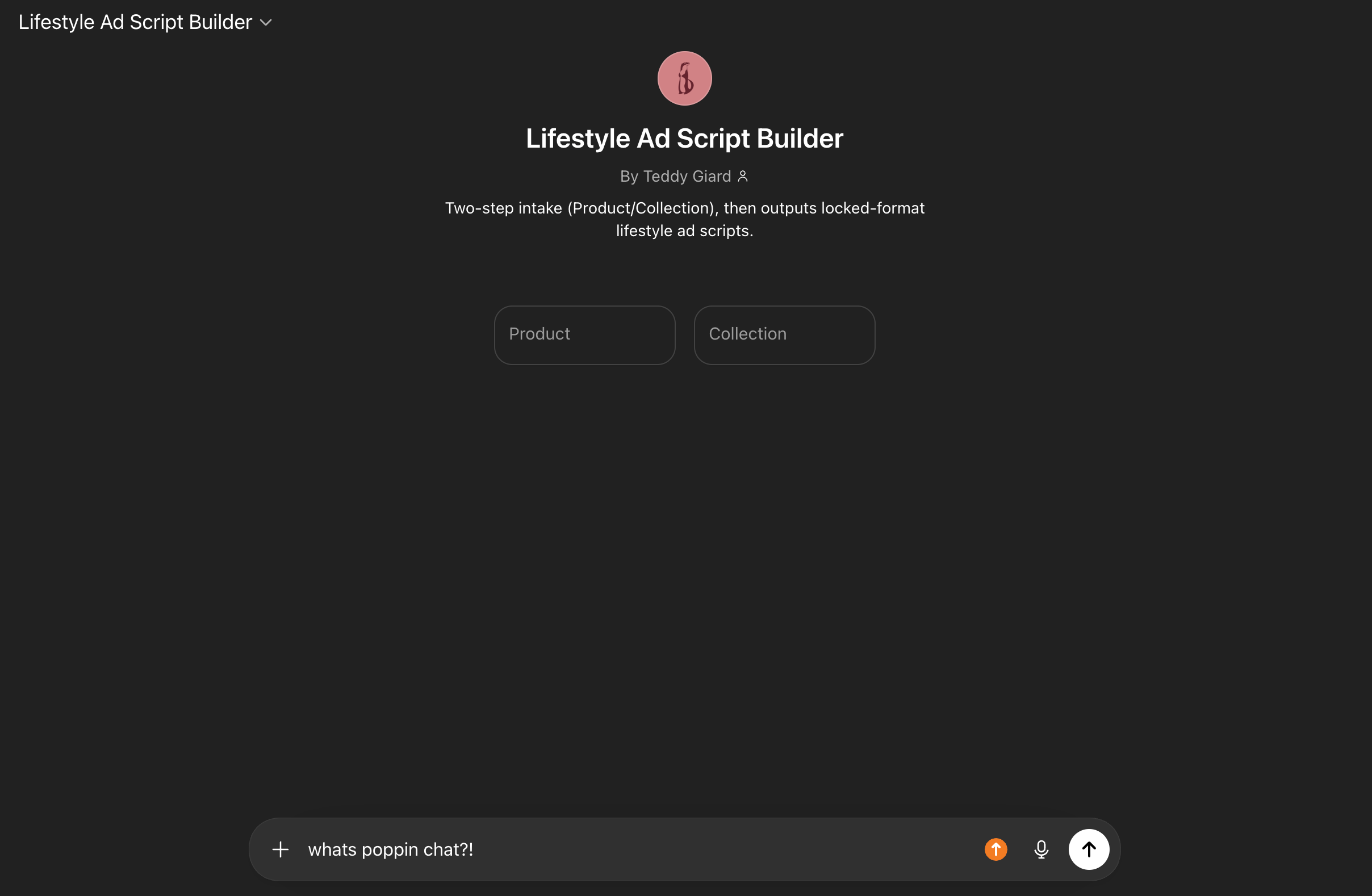
We built a custom GPT that does the heavy lifting: Check it
What AI does
You input: Product name, key features, target audience, emotional angle, collection context.
It outputs: Scripts for all 4 tiers. Tech story. Tech lifestyle story. Lifestyle story. UGC framework. MGC framework. Includes text-on-screen copy, voiceover scripts, positioning angles specific to that collection.
It also gives you 3 different hook options to choose from. You get to pick which one feels natural to you, or scrap all 3 and make your own.
Treat these as an outline that gets you 70% of the way there.
You do the rest
Go ahead and add your voice to the copy. Choose which clips match each tier. (If you don’t have many shots of your product, check out this tool to make more.)
Add your unique voice, perspective and story. Then get to recording.
So now, you don’t have to write 40 scripts from scratch. You can edit and shape 5-10, then replicating them with different footage.
Testing at scale: what the data tells you
This is where it gets fun. You get to put on your strategy hat.
You’re testing three things:
1. Which stories resonate with which audiences? Does the Tech story work better for your gym collection, but the Lifestyle story kills it for your mountain biking collection? You’re going to find out fast.
2. Which price points prefer which angles? Premium customers want specs. They want to know why it’s worth the money. Value customers want aspiration. They want to know who they can become.
3. Which clips hold up across multiple ad sets? This is the currency. If a certain shot of your water bottle performs well in your road running ad, in your seasonal campaign, and in your collection ads, that clip is gold. You can remix it infinitely.
Launch your collection campaigns with different stories. Watch which ones have the highest scroll-stop rates. Which drive clicks. Which convert.
Take the best-performing shots. Feed them back into your seasonal campaign.
Data can often be misleading, here’s how to cut through the BS.
Now, your ad spend becomes R&D. Every dollar you spend testing collection campaigns helps you identify footage that will work for years in your big awareness push. The seasonal campaign becomes lucrative long-term because it’s built from real performance data.
We want to help you call your shots so your brand can kill it. If you’d be interested in letting us give you a hand, we’re launching a Slack community where we’ll meet weekly to help you crush. If interested, check out this survey.
What You Need
Usable footage. Multiple angles. Different contexts. Different people. If your footage is all the same angle, your scripts can’t be unique. More angles equal more flexibility to match script to visual.
Willingness to test and iterate. This isn’t set-it-and-forget-it. You’re going to launch some ads that don’t work, and that’s the point. You’re collecting signal.
Discipline to log what works. Spreadsheet. Doc. Whatever. But you have to track which stories perform with which audiences, which price points, which collections. That data is your roadmap.
Ability to edit and batch creatives. In-house or outsourced. But you need to move fast. Test fast = learn fast.
The highest scroll-stop and click-through rates come from differentiation. From testing multiple angles. From refusing to guess. That takes work, but it works.
Starting small: if you haven’t launched yet
If you haven’t launched yet, start with one product and use the GPT to make your five story tiers.
Same funnel works whether it’s one product or fifty. As you grow, unique stories for each collection start feeding their own campaigns. This system grows with you.
You got this!
Thanks for reading, forward this to whoever makes your ads, or save it for when you start.
Unapologetically bootstrapped,
Giard & Co.